Backup, DR and Troubleshooting
Backup
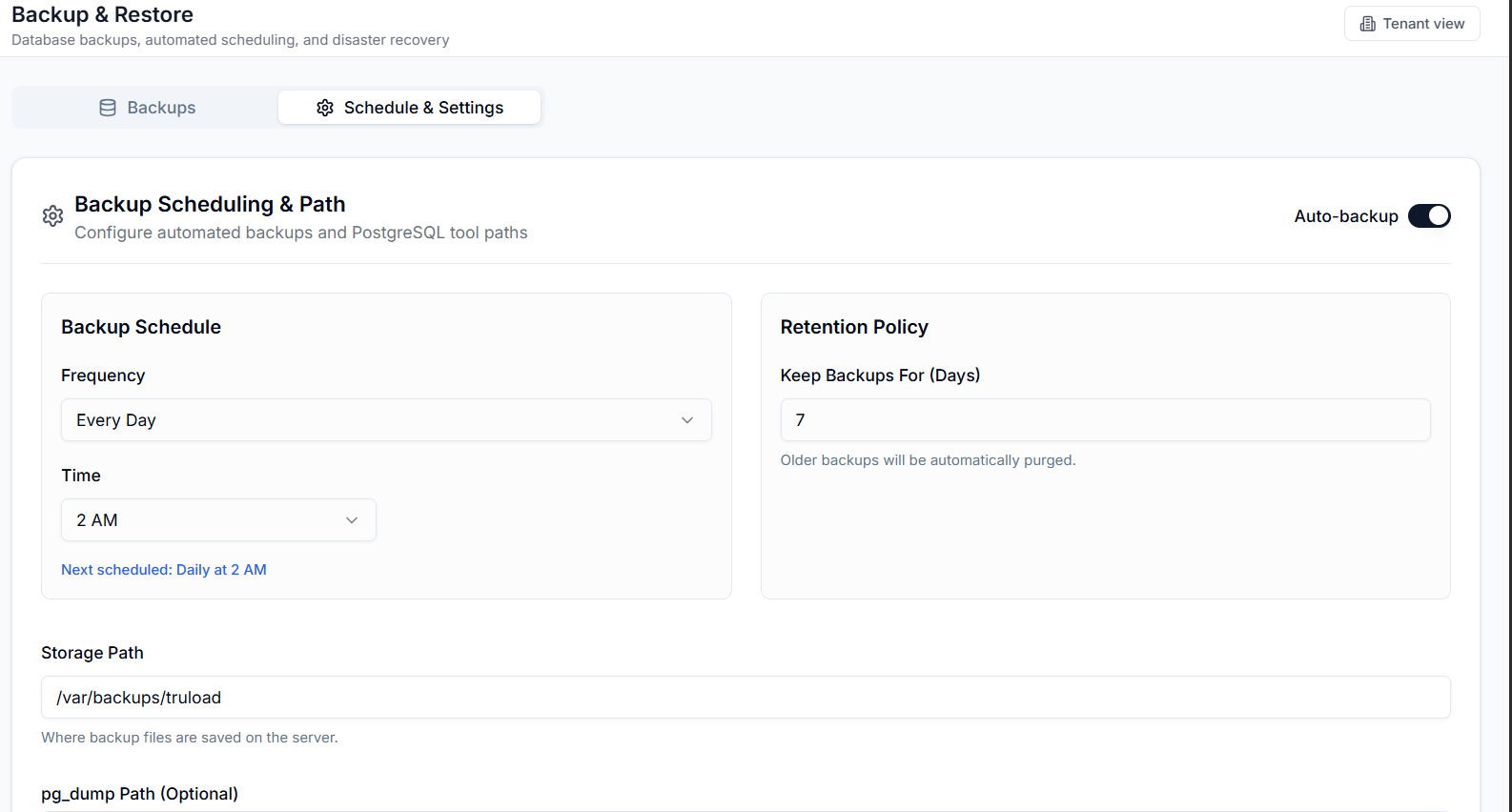
PostgreSQL dumps run nightly from a CronJob that writes to the
truload-backups PersistentVolumeClaim (20 GiB, local-path storage
class). Retention: 7 days on test, 30 days on production.
Media uploads live on the truload-backend-media PVC (10 GiB) and are
snapshotted daily to the same backup volume.
Manual backup before a major release:
- Trigger the backup CronJob from the backend admin screen, or
kubectl -n truload create job --from=cronjob/truload-backup backup-$(date +%s). - Record the job ID and timestamp in the operations log.
- Verify the resulting dump in
truload-backups.
Restore drill
Run once a month against an isolated namespace. The drill is complete when:
- The selected dump restores cleanly into a fresh PostgreSQL instance.
- The backend comes up against the restored DB and passes its readiness probe.
- A smoke run of the compliance end-to-end suite passes against the restored environment.
Record drill outcomes in the ops log; an unsuccessful drill is a sev-2 incident requiring immediate follow-up.
Disaster recovery
Recovery objectives:
| Tier | RPO | RTO |
|---|---|---|
| API (read) | 1 h | 30 min |
| API (write) | 24 h | 2 h |
| Full data-path | 24 h | 4 h |
Sequence:
- Declare the incident and notify stakeholders.
- Freeze writes where required.
- Restore in order: infrastructure (PostgreSQL, Redis, RabbitMQ), backend, frontend, TruConnect connectivity.
- Smoke: auth, weighing, case, prosecution, payment.
- Publish recovery completion and the post-incident report.
Closed-space and intermittent-network operation
TruConnect runs entirely on the station workstation, so scale capture continues even when the upstream link is down. The frontend queues mutations in IndexedDB via Dexie and replays them when connectivity returns. Idempotency keys generated client-side guarantee the backend processes each mutation at most once.
Pesaflow is the one integration with hard online requirements; payment settlement simply cannot proceed without reachability. Callback retries and the reconciliation poll handle transient failures automatically.
Troubleshooting
- Identify the affected module and environment.
- Collect the correlation ID from the error response.
- Check dependency health:
kubectl -n truload get pods,kubectl -n infra get pods, Grafana atgrafana.codevertexitsolutions.com. - Apply the relevant runbook step.
- Capture a post-incident note with timestamps.
Quick map
| Symptom | First thing to check |
|---|---|
| No live weight in browser | TruConnect running, WebSocket port not blocked, input source matches scale |
| Weighing capture 5xx | Backend pod logs + correlation ID; DB health in infra |
| Payment stuck pending | Pesaflow reachability, callback handler logs, reconciliation job state |
| Case won't close | Prerequisite records (payment, reweigh, memo) — verify every link |
| Slow reports | Redis health, PostgreSQL CPU + slow-query log |